

Penix Restores Atlanta
Atlanta found its offense, Bijan kept the valuable backfield work and Green Bay produced two usable receivers—but no lead running back.
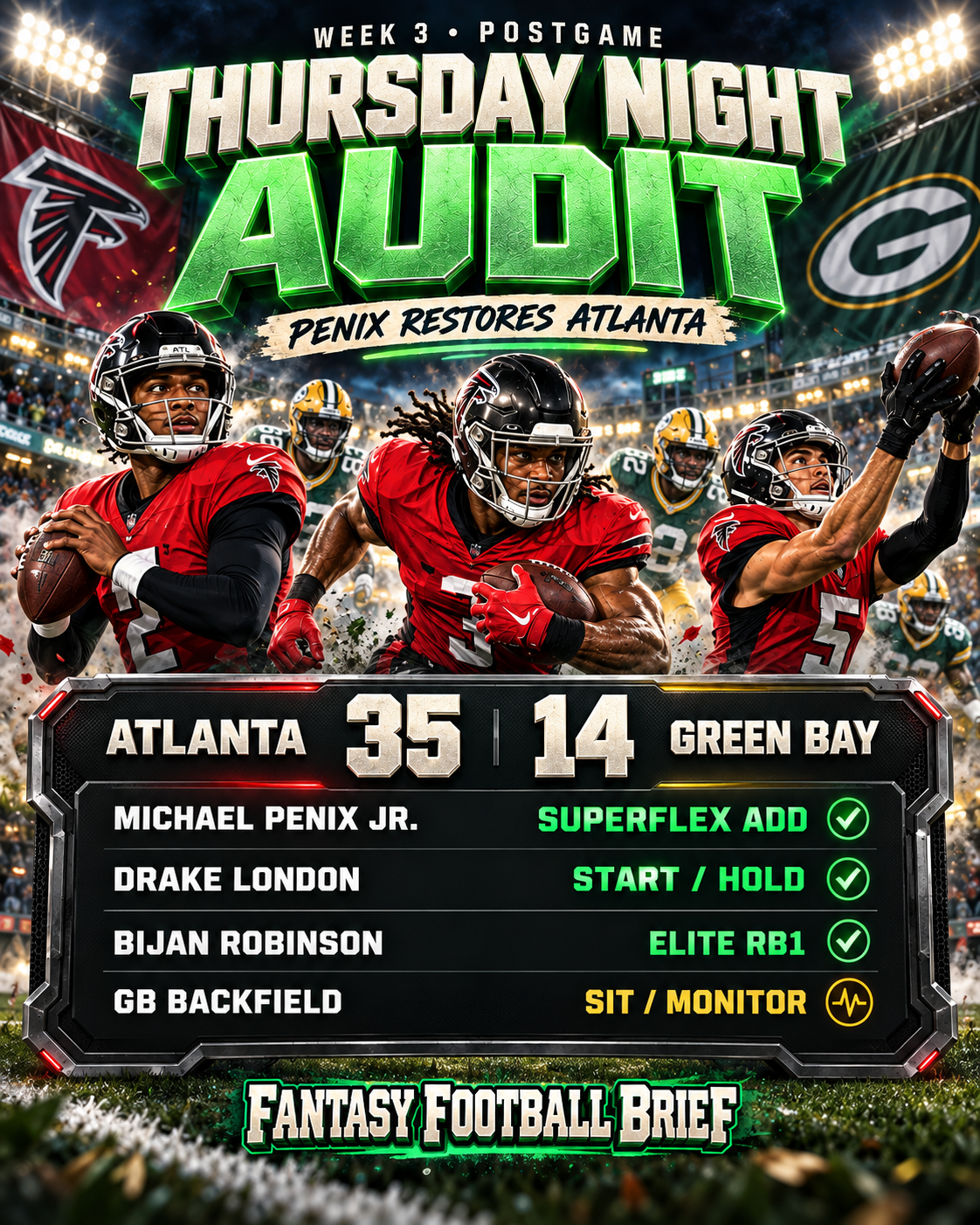
The game changed Atlanta's floor
Atlanta beat Green Bay 35–14 after scoring 16 combined points in its first two games. Penix completed 18 of 25 passes for 256 yards, one touchdown and one interception in his first start since last season’s ACL tear. The beginning was unstable—one completion and an interception on his first five throws—but the rest of the night looked like a functional offense: 17 completions on his final 20 attempts for 239 yards and a touchdown.
The important conclusion is not that Penix is suddenly a locked-in one-quarterback starter. Atlanta controlled possession for 37:05, ran 41 times and needed only 25 throws. The actionable change is that London, Bijan and the rest of the offense again have a credible passing environment.
The move: Add Penix in Superflex and 2QB leagues. In one-QB leagues, monitor him behind established starters until a less favorable script tests his volume and pressure response.
London was the passing game
London caught nine passes for 194 yards—75.8% of Penix’s passing yardage. He supplied the explosive plays and the drive-extending work while no other Falcon reached 20 receiving yards. That is a much stronger fantasy signal than Atlanta’s lone receiving touchdown going to Austin Hooper.
Final route and target totals were not available at publication. That prevents a precise targets-per-route calculation, but it does not erase the concentration already visible in the official receiving line. London remains ROS WR8; confidence in the role rises while the rank stays where the existing projection already placed him.
Pitts finished with one catch for five yards in a game Atlanta controlled on the ground. Hold rather than panic-drop. Friday’s route participation and target rate will tell us whether this was a script loss or a role loss.
Bijan owned the work that matters
Bijan handled 29 of Atlanta’s 39 running-back carries for 194 yards and two touchdowns, then added two catches for 19 yards. That is 74.4% of the backfield’s carries, and both of Atlanta’s inside-the-five rushing scores belonged to him. Brian Robinson handled the other 10 carries for 50 yards and scored from seven yards.
The redistribution is coherent: Bijan retained the primary, explosive and goal-line lanes; Brian supplied relief work and a secondary red-zone touch without displacing him. Bijan remains ROS RB2. Brian remains a deep-bench hold and direct contingency, not a standalone waiver priority created by the touchdown.
Green Bay's receivers survived the bad script
Jordan Love attempted 53 passes after Green Bay fell behind and finished with 312 yards, two touchdowns and one interception. Watson posted 7-96-1; Golden posted 5-100-1. Both belong on rosters, but 53 attempts are a catch-up extreme—not the next-game baseline.
Watson led receptions and entered the game as the projected target leader. Golden led yards and made another explosive play. Until final routes, targets and first-read data show a material reversal, the order stays Watson first and Golden second. A WR1 label does not automatically assign targets, but neither does a slot-fit narrative override demonstrated target earning.
Kraft caught four passes for 26 yards. He remains a TE1-range hold, but the expected Jayden Reed opportunity did not turn into a breakout box score. Friday’s final participation data will determine whether his projection needs more than ordinary confirmation.
The Packers have a backfield problem, not a winner
Lloyd and Johnson split eight running-back carries 4–4. Lloyd gained 11 yards and caught two passes for seven; Johnson gained six yards and caught one pass for 10. The Packers managed 17 rushing yards from their backs while playing from behind.
That line does not identify the next starter. Negative script suppressed the team rushing budget, but neither back separated in the work that survived. Snap counts, routes, two-minute deployment and pass-protection substitutions are still required before treating the split as planned, performance-driven or temporary.
The move: Sit both. Hold only where backfield access has value, and do not pay for a lead role the game did not reveal.
ACE ranks: confirmation without box-score chasing
Week 3 ranks are preserved as the pregame record because the players have already played. The current rest-of-season comparison is the September 22 authoritative edition. The game strengthened confidence in Atlanta’s core without supplying the route-level evidence required for a precise reordering tonight.
| Player | Previous → current | Direction and horizon | Next checkpoint |
|---|---|---|---|
| Penix | ROS QB27 → QB27 | Hold rank · confidence up | Friday pressure and route data |
| London | ROS WR8 → WR8 | Hold rank · confidence up | Final targets and routes |
| Bijan | ROS RB2 → RB2 | Hold · elite role confirmed | No change unless health does |
| Watson | ROS WR24 → WR24 | Hold target-order lead | Friday targets per route |
| Golden | ROS WR33 → WR33 | Hold · role confirmed | Friday targets per route |
| Lloyd | ROS RB37 → RB37 | Hold rank · role confidence down | Snaps, routes and pass protection |
The postgame action board
| Player | Action | Why |
|---|---|---|
| Michael Penix Jr. | Add · Superflex/2QB | The return restored a functional Atlanta passing baseline. Monitor in one-QB leagues; the 25-attempt win script did not create an automatic weekly QB1. |
| Drake London | Start · Hold | Nine catches for 194 yards made London the clear passing-game center. Final routes and targets are Friday's durability check. |
| Bijan Robinson | Start · Hold | He handled 29 of 39 Atlanta RB carries and both inside-the-five touchdowns. Nothing in the split weakened his elite role. |
| Brian Robinson Jr. | Hold · Deep leagues | Ten carries and a seven-yard touchdown preserved direct-contingency value, but Bijan retained the high-value rushing work. |
| Christian Watson | Hold | Seven catches, 96 yards and a score supported his lead-receiver treatment. Preserve the pregame hierarchy until route and target rates are final. |
| Matthew Golden | Hold | Five catches, 100 yards and a score were useful confirmation of a meaningful role—not evidence by themselves that he passed Watson. |
| MarShawn Lloyd | Sit · Monitor | Four carries, two catches and no decisive lead role. Friday's snaps, routes and protection assignments determine whether the split was script or structure. |
| Kaleb Johnson | Sit · Monitor | Four carries and one catch produced no startable role. Do not treat a nominal depth-chart label as a fantasy workload. |
| Tucker Kraft | Hold | Four catches kept him involved, but the expected Jayden Reed redistribution did not create a target spike. |
| Kyle Pitts | Hold · Monitor | One catch for five yards is a concern, but one run-heavy game is not enough to declare a durable route or target collapse. |
What Friday can still change
Final snaps, routes, target totals, first-read participation and Green Bay’s protection assignments can change confidence—and could justify a later rank move. They cannot change tonight’s clearest decisions: Penix restored the offense, London and Bijan remain centerpieces, Watson stays ahead of Golden pending hierarchy evidence, and the Packers did not produce a startable lead back.